Most businesses need automation, not an AI agent. Use automation for predictable rules, RAG to answer questions from your own data, and AI agents only for multi-step work that spans systems. At Unbland, AI Systems start from $8,000 plus a retainer, and we scope which layer fits so you don't overpay for AI where a simple rule works.
The three terms get used interchangeably in sales decks, and that is how companies end up paying for an autonomous agent to do what a scheduled script handles for a fraction of the cost. The difference is not academic: it decides your build time, your maintenance burden, and your bill. Here is how to tell them apart and pick the layer your problem actually needs.
AI agent vs automation vs RAG: what's the actual difference?
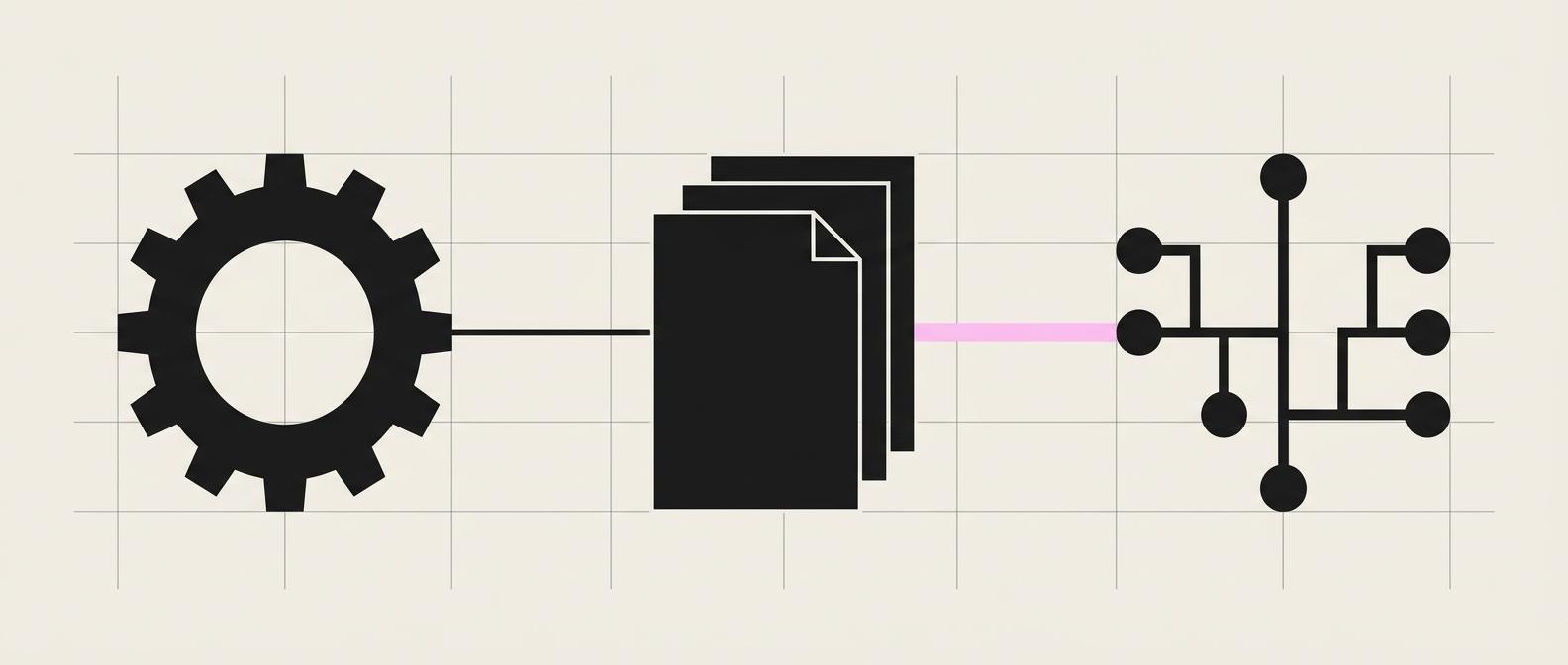
These are three different tools for three different jobs. Here is the short version:
- Automation is deterministic and rule-based: "if this, then that." It follows a fixed path you define in advance. Best for predictable, repetitive steps like moving a form submission into your CRM or sending a reminder on a schedule. No model required, and no surprises.
- RAG (retrieval-augmented generation) answers questions from your own data and shows its sources. It retrieves the relevant documents, then a language model writes an answer grounded in them. Best for support chatbots built on your docs, internal knowledge bases, and compliance answers that need an audit trail. It typically takes 4 to 8 weeks to implement and often delivers the fastest ROI (source: Bitcot; Sprinklr).
- AI agents are autonomous, multi-step workflows that coordinate across systems and APIs and make dynamic decisions about what to do next. Best when a task spans several tools and the path is not fixed in advance. Agents typically take 12 to 24 weeks and often carry the highest long-term ROI (source: Airbyte; Techment).
A fourth option sits alongside these: fine-tuning, where you custom-train a model because off-the-shelf output is not close enough on tone, format, or domain language. Fine-tuning typically runs 8 to 16 weeks (source: Techment).
The main axis to remember: automation follows rules you wrote, RAG answers from knowledge you own, and agents take actions you delegate.
Do I need an AI agent or automation?
Start with automation and only move up when it genuinely cannot do the job. Ask one question: is the path fixed?
If the steps are the same every time, you need automation, not an agent. A rule engine is cheaper to build, easier to test, and far easier to trust in production because it does exactly what you told it to. Examples:
- Route a new lead to the right salesperson based on region.
- Sync inventory between two systems every night.
- Send a payment-failed email when a charge is declined.
You need an AI agent only when the path changes based on what the system finds mid-task, and when completing the work requires deciding across multiple tools. Examples:
- Read an inbound support ticket, look up the account, check the order status in a second system, issue a refund if policy allows, and draft the reply.
- Research a list of companies, pull data from several sources, and compile a scored shortlist.
If you can draw the full flowchart on a whiteboard with no "it depends" branches driven by unpredictable content, automation wins. The moment the decision needs to read unstructured input and choose between real actions, an agent earns its cost. Our AI agents service exists for exactly that second case, and we will tell you when you are better served by a plain automation.
When should I use RAG instead of an AI agent?
Use RAG when the job is answering questions, and an agent when the job is taking actions. This is the distinction people most often get wrong.
RAG is the right call when:
- People keep asking the same questions and the answers already live in your documents, policies, or product data.
- Answers must be grounded in your own content and cite where they came from, so nobody has to trust a black box.
- You need an audit trail for compliance or support quality.
An agent is overkill for that. If all you need is a support assistant that reads your help center and answers accurately with sources, RAG gets you there in weeks, not months, which is why it so often shows the fastest payback (source: Bitcot). It is also the safer starting point, because a retrieval system that quotes your docs is much easier to review than an autonomous process that can act on live systems.
Reach for an agent only when answering is not enough and the system has to do something across tools afterward. Many real products layer both: RAG answers the customer's question, and if the answer is "we need to update your subscription," an agent or a scripted automation carries out that change. We build the retrieval and language-model side through our AI integration service.
RAG vs AI agents for business: which has better ROI?
They optimize for different timelines, so "better" depends on what you are measuring.
- RAG usually wins on speed to value. At 4 to 8 weeks and often the fastest ROI, it is the pragmatic first project when you have a document-heavy problem (source: Sprinklr). You get a working, source-cited system quickly and can measure deflected support tickets almost immediately.
- AI agents usually win on long-term upside. At 12 to 24 weeks they cost more to build, but for workflows that span many tools they carry the highest long-term ROI because they remove ongoing manual coordination, not just answer questions (source: Techment).
The market backs this direction: the agentic AI market is projected to grow from about $7B in 2025 to roughly $93B by 2032 (source: Sprinklr). That growth is real, but it is not a reason to start with an agent. It is a reason to build the cheaper, faster layers first and add agents where they clearly pay for themselves.
Our honest position: for most first AI projects, RAG or a well-built automation returns value sooner and de-risks the bigger investment. Agents are worth it when a specific, expensive, multi-tool process is eating your team's time.
How do I decide? A four-step framework
Walk down this list and stop at the first layer that solves your problem:
- Automation when the rule is predictable and the path is fixed. Cheapest, most reliable, no model needed.
- RAG when the job is "answer from our own knowledge" with sources and an audit trail.
- AI agents when the job is "take multi-step actions across systems" and the path is decided at runtime.
- Fine-tuning when tone, format, or domain language must be baked into the model itself because prompting and retrieval are not enough (source: Techment).
Most real systems combine them. A support product might use RAG to answer, an automation to log the ticket, and an agent only for the small set of cases that require action across tools. Fine-tuning gets added later if the model's voice needs to be consistently on-brand.
[Team: insert your own before/after metrics here once you have them, e.g. average tickets deflected or hours saved on a shipped RAG or agent build.]
What does this cost, and how does Unbland scope it?
At Unbland, AI Systems start from $8,000 plus a retainer, and that scope covers the full range: agents, automation, data pipelines, LLM integration, RAG and vector search, and fine-tuning. We are a senior-only team of six co-founders, we work fixed-price with no hourly billing, and you own everything at the end, including source code, docs, and assets.
The part that saves you money is the scoping. Before we build, we map your task to the lowest layer that solves it, so you are not paying for an autonomous agent when a nightly automation and a RAG endpoint do the work. Every engagement includes a 30-day handover call and 30 days of support, so the system stays something your team can run without us.
Frequently asked questions
Do I need an AI agent or automation?
Start with automation. If the path is fixed and the same every time, a rule-based automation is cheaper, more reliable, and easier to trust. Choose an agent only when the task requires reading unpredictable input and deciding between real actions across multiple systems.
When should I use RAG vs an AI agent?
Use RAG when the job is answering questions from your own data with source attribution. Use an agent when the job is taking multi-step actions across tools. Many products use both: RAG to answer, an agent to act.
How long does RAG take to implement?
RAG projects typically take 4 to 8 weeks and often deliver the fastest ROI of the AI options, because you are grounding a model in content you already own rather than building autonomous behavior (source: Bitcot; Sprinklr).
Can I combine automation, RAG, and agents?
Yes, and most real systems do. A common pattern is automation for the fixed steps, RAG to answer questions with citations, and an agent only for the subset of cases that need action across several tools, with fine-tuning added later if tone or format must be consistent.
How much does an AI system cost at Unbland?
AI Systems start from $8,000 plus a retainer, covering agents, automation, RAG and vector search, pipelines, LLM integration, and fine-tuning. Fixed-price, senior-only, and you own the code and assets at handover.
Not sure which layer you need? Tell us the task on our AI agents service page or start a scope at our contact section.
Sources
- Bitcot — RAG vs Agentic RAG vs MCP: https://www.bitcot.com/rag-vs-agentic-rag-vs-mcp/
- Sprinklr — Agentic AI vs RAG: https://www.sprinklr.com/blog/agentic-ai-vs-rag/
- Airbyte — AI Agent vs RAG: https://airbyte.com/agentic-data/ai-agent-vs-rag
- Techment — RAG vs Fine-Tuning vs AI Agents: https://www.techment.com/blogs/rag-vs-fine-tuning-vs-ai-agents-llm-strategy/